
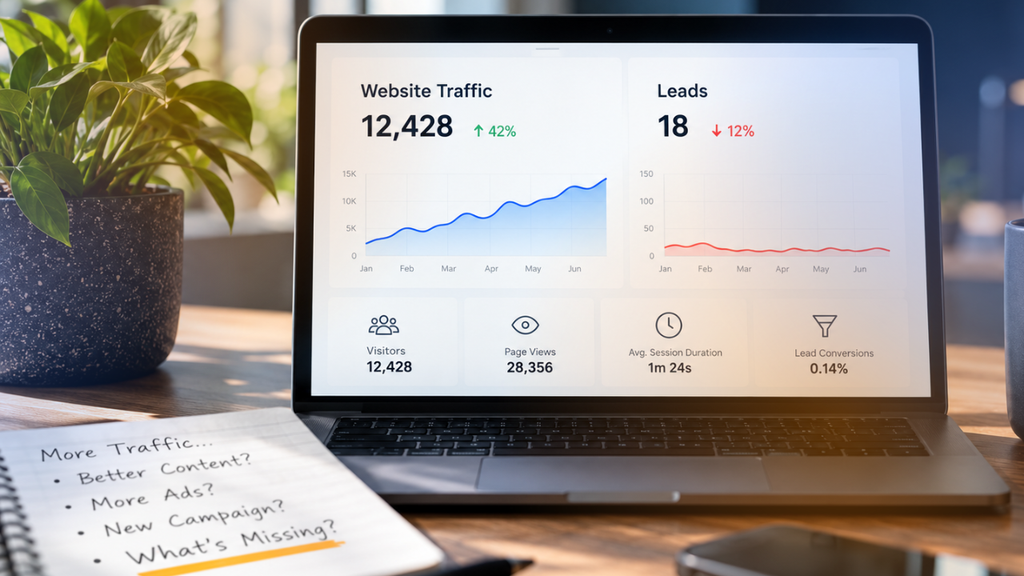
More people are finding your business through Google, clicking on your ads, and visiting your pages. That sounds like progress.
But when you check your inbox, the number of new inquiries hasn’t changed much. Your contact form is quiet, consultation bookings are rare, and all that extra traffic doesn’t seem to be turning into actual business opportunities.
It’s frustrating, especially when you’re already investing time and money into marketing.
The natural reaction is to assume you need more visitors. Maybe another advertising campaign, a bigger budget, or a stronger social media presence will help.
But what if traffic isn’t the problem?
If your website is not generating leads, the answer may have less to do with how many people visit and more to do with what happens once they arrive.
Let’s look at some of the most common reasons visitors leave without getting in touch, and what businesses should pay attention to before spending more money on traffic.
1. People Visit Your Website but Don’t Understand What You Actually Do
Here’s a simple question: Could someone who has never heard of your business understand what you offer within a few seconds of landing on your homepage?
It sounds obvious, but plenty of websites make visitors work surprisingly hard to find that answer.
You might see headlines like:
“Innovative Solutions for a Better Tomorrow.”
Or:
“Helping Businesses Reach Their Full Potential.”
These statements sound professional, but they don’t tell visitors much.
What kind of solutions? For which businesses? What problems do you solve?
When someone lands on your website, they’re usually trying to answer a few basic questions:
- Am I in the right place?
- Can this business help with my problem?
- Why should I choose them?
- What should I do next?
If the answers aren’t clear, visitors may leave before exploring further.
Clear Messaging Matters More Than Clever Messaging
You don’t need a complicated headline to make a strong impression.
Imagine a company offering website development services.
Instead of saying “Transforming Digital Possibilities,” it could say:
“Custom Website Design and Development for Growing Businesses.”
It’s less abstract, but it immediately explains the service and who it’s for.
Your website can still have personality, creativity, and distinctive branding. Those elements are important.
But they should support your message, not make it harder to understand.
A useful starting point is to review your homepage and key service pages from the perspective of someone who knows nothing about your business.
Would they understand the value of your services without having to guess?
2. You’re Attracting Visitors Who Aren’t the Right Fit
Not all website traffic is equally valuable.
Imagine two businesses.
One receives 10,000 monthly visitors, but most are looking for free information unrelated to its paid services.
The other receives 1,000 visitors, many of whom are actively researching a service the business offers.
Which website has a better opportunity to generate qualified leads?
The second one may have a stronger chance, even with significantly less traffic.
This is why traffic numbers alone can be misleading.
A website can attract visitors through search engines, social media, and advertising without necessarily reaching people who are interested in becoming customers.
For example, a digital agency might publish a popular article about free design tools. The article could attract plenty of readers, but many of them may have no intention of hiring an agency.
That doesn’t make the content useless. It simply means those visits serve a different purpose.
Look Beyond the Number of Visitors
When reviewing your website performance, consider where visitors are coming from and what they’re looking for.
Are they searching for information, comparing providers, or actively looking for a service?
Are your marketing campaigns reaching the audience your business wants to work with?
And which pages are attracting people who eventually submit inquiries?
Understanding visitor intent helps you make better decisions about content, SEO, and advertising.
More traffic isn’t always the answer. Sometimes you need more of the right traffic.
3. Your Website Makes People Work Too Hard
Think about the last time you visited a website and couldn’t find what you needed.
Maybe the navigation was confusing. Maybe the information was spread across several pages. Or perhaps you kept clicking links that didn’t lead where you expected.
How long did you keep trying?
Probably not very long.
Your potential customers are no different.
They might be genuinely interested in your services, but that doesn’t mean they’re willing to spend ten minutes figuring out how your website works.
A poor user journey can quietly cost businesses valuable inquiries.
The Problem Isn’t Always Obvious
Sometimes a website looks great but still feels difficult to use.
For example, a visitor lands on a service page, reads about the offering, and wants to know what happens next.
But there’s no clear link to a related case study, no obvious contact option, and no explanation of how the process works.
The visitor has reached a dead end.
Other common problems include complicated menus, too many competing options, unclear page structure, and important information hidden behind unnecessary clicks.
The goal of good website design isn’t to force every visitor down the same path.
It’s to make relevant information easy to find and help people move forward when they’re ready.
A visitor who wants to learn more should be able to explore. Someone who’s ready to request a quote shouldn’t have to search for the contact page.
Good user experience removes unnecessary effort from the decision-making process.
4. Your Calls to Action Aren’t Giving People a Reason to Click
Most business websites have buttons that say things like:
“Learn More.”
“Contact Us.”
“Submit.”
There’s nothing inherently wrong with these phrases. But they’re not always the most helpful way to guide visitors.
Imagine someone reading about your website development services.
At the bottom of the page, they see a button that says “Contact.”
What happens after they click? Are they requesting a quote, booking a consultation, or simply sending a general message?
Now compare that with:
“Let’s Discuss Your Website Project.”
The second option gives visitors a clearer idea of what they’re doing.
A good call to action doesn’t need to be aggressive or overly promotional. It simply needs to make sense in the context of the page.
Different Visitors Need Different Next Steps
Not everyone visiting your website is ready to contact you immediately.
Some are still exploring their options. Others are comparing providers or trying to understand what a project might involve.
That’s why it helps to think about calls to action throughout the customer journey.
Someone researching a service might appreciate a relevant case study or a detailed service page.
Someone who has already reviewed your work might be ready to schedule a conversation.
The key is to give people a useful next step instead of assuming every visitor is ready to make the same decision.
And remember, adding more buttons doesn’t automatically improve conversions.
Sometimes too many competing calls to action make it harder for visitors to decide what to do.
5. Your Website Looks Professional but Doesn’t Build Enough Trust
A polished website creates a good first impression.
But looking professional and feeling trustworthy aren’t quite the same thing.
Visitors may like your design and still hesitate to contact you.
Why?
Because hiring a service provider often involves uncertainty.
Will this company understand what we need? Have they worked on similar projects? What will the process look like? Can we trust them to deliver?
Your website should help answer those questions.
Show People Why They Can Trust Your Business
Think about what someone would want to know before choosing a company like yours.
Real examples of previous work can demonstrate your capabilities more effectively than broad statements about quality.
Client testimonials can provide useful perspectives on what it’s like to work with your team.
Clear service descriptions help set expectations, while an informative About page can make the business feel more approachable.
Even small details matter.
Up-to-date information, working links, consistent branding, and straightforward contact details all contribute to the overall impression.
Of course, trust signals should always be genuine. Invented testimonials, exaggerated claims, and unsupported performance statistics can do more harm than good.
You don’t need to convince visitors that your business is perfect.
You need to give them enough relevant information to feel comfortable taking the next step.
6. Your Contact Form Might Be the Reason You’re Losing Leads
This is one of the easiest problems to overlook.
A visitor has explored your website, read about your services, and decided to get in touch.
They click the contact button.
And then they see a form asking for their full name, company name, phone number, email address, job title, industry, company size, budget, project timeline, and a detailed description of their requirements.
That’s a lot to ask from someone who may simply want to start a conversation.
The more effort required to complete a form, the more opportunities there may be for visitors to abandon it.
But there’s another issue: sometimes contact forms don’t work as expected.
Messages may fail to send, notifications may go to the wrong inbox, or visitors may receive no confirmation that their inquiry was submitted.
From the business owner’s perspective, it can look like nobody is interested.
In reality, potential customers may be trying to reach out.
Make Getting in Touch Feel Easy
A contact form should collect enough information to start a useful conversation without creating unnecessary obstacles.
For many service businesses, a name, email address, and short message may be a reasonable starting point. More complex projects may require additional details.
The right balance depends on your business and how your team handles inquiries.
It’s also worth testing your forms regularly, especially after website updates.
Submit a test inquiry. Check whether the notification arrives. Confirm that the form works on mobile. Make sure visitors receive a clear success message.
These are small checks, but they matter.
A website can’t generate leads effectively if people struggle to contact you.
7. Your Mobile Experience Is Working Against You
A website might look excellent on a desktop monitor and feel completely different on a phone.
Text becomes difficult to read. Buttons sit too close together. Images take up too much space. Forms become awkward to complete.
Sometimes important information gets pushed so far down the page that visitors never reach it.
And because many people discover businesses through social media, search, and advertising on their phones, mobile usability deserves serious attention.
Responsive design is a starting point, but it doesn’t automatically guarantee a good mobile experience.
You still need to consider how people actually interact with the website on smaller screens.
Can they understand your main message without excessive scrolling? Are buttons easy to tap? Is the navigation straightforward? Can they complete the contact form comfortably?
Website speed matters here, too.
Large images, unnecessary scripts, and poorly optimized elements can make pages slow or frustrating to use, particularly on less reliable connections.
You don’t need to redesign everything to improve the experience.
Sometimes adjusting the mobile layout, simplifying navigation, optimizing images, or improving a form can make a meaningful difference.
8. You’re Looking at Traffic Reports but Missing the Bigger Picture
Let’s say your website receives 5,000 visitors this month.
Is that good?
The answer depends on what those visitors do and what your business is trying to achieve.
Traffic reports can tell you how many people visit your website and where they come from.
But they don’t automatically explain why those visits aren’t becoming inquiries.
To understand that, you need to look a little deeper.
Which pages are attracting visitors? Which pages are people leaving? Are visitors reaching your contact page? Are they clicking important calls to action? Are forms being submitted successfully?
And perhaps most importantly, which inquiries are turning into genuine business opportunities?
Don’t Confuse Activity With Results
A popular blog post can be valuable for brand awareness and search visibility without immediately generating leads.
A service page with relatively little traffic might produce more qualified inquiries.
Both pages can have a role, but they shouldn’t necessarily be judged by the same metric.
It’s also important to remember that analytics don’t reveal everything.
A high exit rate doesn’t automatically mean a page is poorly designed. Visitors may have found the information they needed. Similarly, a low conversion rate could reflect a mismatch between the audience and the offer rather than a technical website problem.
Website data is most useful when it’s considered alongside customer feedback, campaign performance, and business goals.
Instead of asking only, “How many people visited our website?” ask:
“What happened during those visits, and what can we learn from them?”
9. Your Website Was Built for Your Business, Not Your Customers
This one can be uncomfortable to recognize.
Businesses naturally want to talk about themselves.
Their history, achievements, services, values, expertise, and processes all feel important.
And they are.
But when every page focuses primarily on the business, visitors may struggle to understand what any of that means for them.
Imagine a service page filled with statements like:
“We have extensive industry experience.”
“We use innovative technology.”
“We deliver high-quality solutions.”
Those claims might be true, but they don’t necessarily explain how the service helps the customer.
A more useful approach is to connect your expertise to the problems your audience is trying to solve.
Instead of simply saying your team builds custom websites, explain what that means for a business that has outgrown its current platform.
Instead of listing technical capabilities without context, show how those capabilities can support easier content management, better integrations, or a smoother customer experience.
Your website should absolutely communicate what makes your business different.
But it should do so in a way that helps visitors understand why those differences matter.
So, How Do You Fix a Website That’s Not Generating Leads?
If your website is getting traffic but not generating inquiries, it’s tempting to start changing everything.
A new homepage. Different colours. More buttons. New copy. Maybe even a complete redesign.
But making changes without understanding the problem can lead to more work without better results.
A more useful approach is to identify where visitors are getting stuck.
Start by reviewing your most important pages.
Look at the messages that bring people to those pages, the information they encounter, and the actions they’re encouraged to take.
Then consider what your analytics, customer questions, and actual inquiries are telling you.
Maybe your advertising is attracting the wrong audience. Maybe your service descriptions are too vague. Perhaps visitors are interested but can’t find enough evidence to trust your business.
Or maybe the issue is as simple as a contact form that isn’t working properly.
Different problems require different solutions.
That’s why improving lead generation is rarely about finding one magic button, headline, or design trend.
It’s about understanding the entire experience and making the parts work better together.
More Traffic Isn’t Always What Your Website Needs
Getting people to visit your website is an important part of digital marketing.
But traffic alone doesn’t build a business.
The real opportunity comes when visitors can quickly understand what you offer, find the information they need, feel confident in your business, and take the next step without unnecessary frustration.
If your website is not generating leads, that doesn’t automatically mean your marketing has failed or that you need to rebuild everything from scratch.
It may mean your website needs a closer look.
At Urban Block Media, we approach website design and development with the bigger picture in mind. From clear messaging and user-friendly design to website functionality, digital marketing, and ongoing improvements, we help businesses create digital experiences that support their goals.
Because attracting visitors is only the beginning.
Your website should give the right people a reason to stay, explore, and start a conversation.
Frequently Asked Questions
Why is my website getting traffic but no leads?
A website may attract visitors without generating leads for several reasons, including unclear messaging, irrelevant traffic, confusing navigation, weak calls to action, missing trust signals, or complicated contact forms. The best way to identify the issue is to review both your traffic sources and what visitors experience after arriving.
What is a good website conversion rate?
There isn’t one conversion rate that applies to every website. Results vary depending on the industry, audience, traffic source, offer, and type of conversion. A business generating consultation requests will likely have different expectations from an e-commerce store or a website offering free downloads. Your own historical performance and lead quality are useful starting points.
Can website design affect lead generation?
Yes. Website design influences how easily visitors understand your services, navigate pages, find relevant information, and complete important actions. Good design supports usability and trust, while confusing layouts or unnecessary friction can discourage potential customers from getting in touch.
Do I need a new website to generate more leads?
Not necessarily. Some websites benefit from targeted improvements to messaging, landing pages, navigation, calls to action, or contact forms. A larger redesign may be appropriate when the website has significant technical limitations, outdated functionality, or structural problems that smaller updates cannot reasonably address.
How can I improve lead generation without increasing website traffic?
Start by reviewing the experience of visitors already reaching your website. Improve unclear service descriptions, simplify contact forms, strengthen relevant trust signals, and make calls to action easier to understand. Tracking meaningful conversions can help you identify which changes deserve priority.